

Views: 0 Author: Site Editor Publish Time: 2026-07-24 Origin: Site


Battery chemistry dictates the physical constraints, safety profile, and lifecycle of modern electronic devices. Power source selection remains a foundational engineering decision for hardware development. Product teams must balance the demand for ultra-slim, lightweight form factors against the need for maximum energy density, longevity, and operational stability. Choosing the wrong battery architecture can lead to product recalls, thermal failures, or compromised user experiences in the field.
This guide provides a direct, evidence-based comparison between traditional lithium-ion cells and Lithium Polymer Batteries. We offer a framework to evaluate which chemistry aligns with specific product requirements, compliance standards, and unit economics. You will find practical data to guide your next hardware iteration.
Understanding the fundamental architecture of the cell helps determine baseline compatibility with product housing and thermal environments. The physical makeup of a battery dictates how it handles stress, heat, and daily operation.
Traditional lithium-ion batteries utilize liquid lithium salt organic solvents as electrolytes. These cells require rigid metal casings, such as cylindrical 18650 or 21700 formats, or prismatic enclosures. The metal casing contains internal pressure and prevents physical deformation during operation. This architecture benefits from a highly mature and optimized automated manufacturing process. Engineers rely on these standardized sizes to design battery packs with predictable thermal dissipation pathways.
The rigid casing also acts as a primary mechanical defense. When a device drops, the steel or aluminum cylinder absorbs the impact, protecting the internal anode and cathode layers from short-circuiting. However, this metal adds significant dead weight to the final product assembly.
Most commercial Lithium Polymer Batteries use a porous polymer gel matrix holding a liquid electrolyte, rather than a true dry solid-state polymer electrolyte. They employ flexible, heat-sealed aluminum laminate foil pouch packaging instead of rigid metal. The lack of a rigid casing fundamentally alters the weight profile, internal pressure dynamics, and mechanical vulnerability.
Because they lack a metal shell, these pouch cells save considerable weight. The aluminum laminate foil is thin and flexible. This allows manufacturers to create custom shapes that fit perfectly into the leftover cavities of a device housing. However, this flexibility means the device's outer shell must provide all the mechanical protection against punctures and crushing forces.
| Feature | Lithium-Ion (Cylindrical/Prismatic) | Lithium Polymer (Pouch) |
|---|---|---|
| Electrolyte State | Liquid organic solvent | Polymer gel matrix |
| Casing Material | Rigid steel or aluminum | Flexible aluminum laminate foil |
| Shape Customization | Standardized (18650, 21700) | Highly customizable |
| Mechanical Durability | High (self-contained protection) | Low (relies on device housing) |
Mapping battery capacity, voltage curves, and power delivery ensures the cell meets device runtime and performance requirements. You must match the electrical output to the load profile of your hardware.
Comparing the energy-to-weight ratio reveals that lithium polymer often excels due to the lack of heavy metal casing. This high gravimetric energy density makes them the standard for aviation and wearable tech. Conversely, traditional lithium-ion typically packs more raw power into a given cubic space, offering higher volumetric energy density. If weight is not a constraint, a cylindrical cell will usually provide more milliamp-hours for the same physical volume.
Standard nominal voltages differ slightly between the two chemistries. Lithium-ion typically operates at 3.6V or 3.7V. High-Voltage Lithium Polymer (LiHV) cells can reach nominal voltages of 3.8V up to 3.85V. Discharge curves affect power consistency as the state of charge depletes. Lithium polymer cells often maintain a flatter discharge curve, delivering consistent voltage until they are nearly empty, which prevents device brownouts during heavy processing tasks.
Lithium polymer batteries often feature high discharge capabilities. High C-ratings make them ideal for high-burst, high-current applications like drones, remote control vehicles, and power-dense medical devices. A 50C lithium polymer pack can dump its entire capacity in minutes without melting the internal tabs. Mass-market lithium-ion cells typically provide steady, sustained, and low-to-moderate continuous discharge characteristics, suited for laptops and electric vehicles.
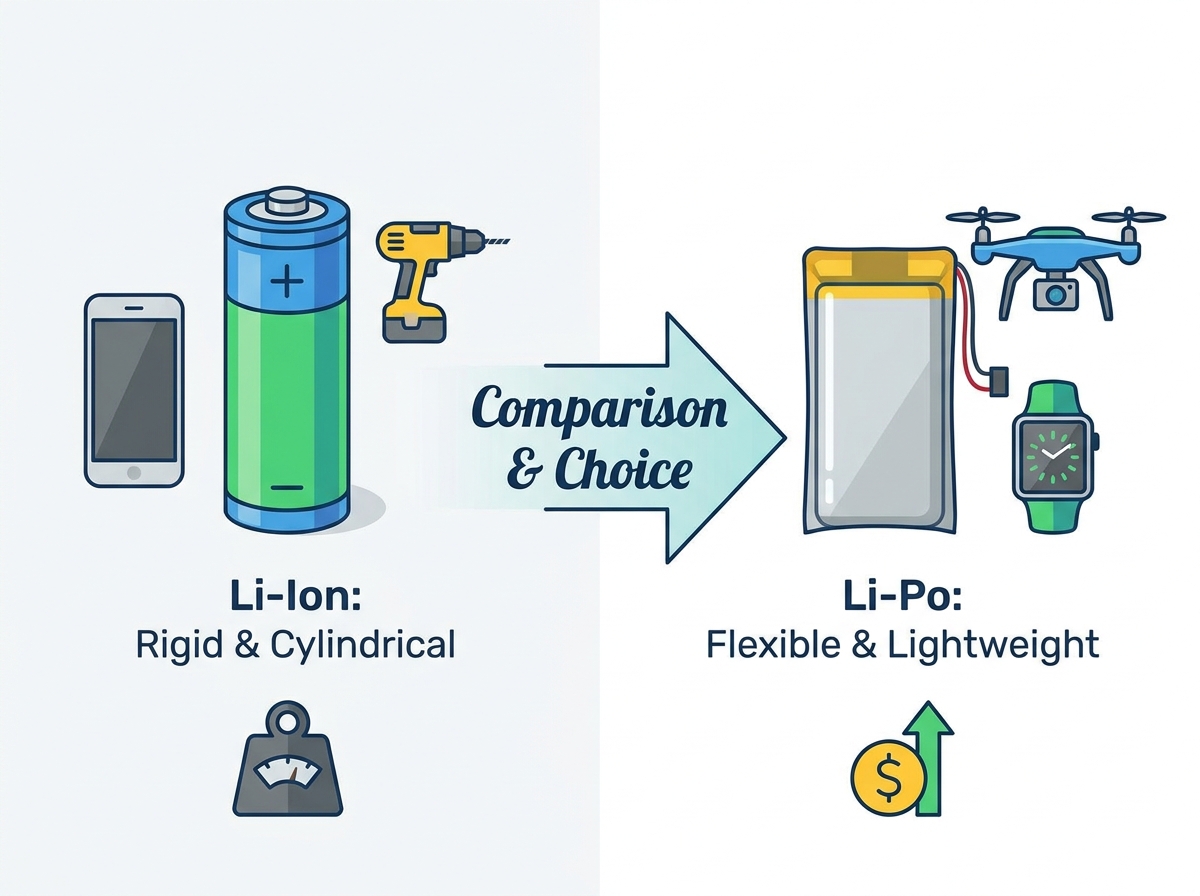
Physical battery constraints dictate overall product industrial design and spatial planning. The battery is often the largest single component in a mobile device.
The customizable footprint, thickness, and aspect ratios of lithium polymer batteries enable ultra-thin devices. They can be manufactured thinner than 2mm, suiting smartphones, wearables, and credit-card-sized hardware. Standardized, rigid lithium-ion cylinders impose design limitations, volumetric waste, and spatial gaps during integration. When you stack cylindrical cells, you inevitably create empty voids between them, wasting valuable internal volume.
Battery weight impacts payload capacity, energy consumption, and flight times in UAVs and portable consumer electronics. Shedding structural weight by removing the protective metal casing benefits mobility but requires careful handling. In drone design, every gram saved on the battery translates directly to increased flight time or heavier camera payloads.
Risk assessment regarding thermal events, mechanical stress, user safety, and product liability remains a primary engineering responsibility.
Traditional lithium-ion cells carry risks of liquid electrolyte leakage, internal short-circuiting, and rapid explosive thermal runaway if the rigid casing is breached or crushed. The liquid solvent is highly flammable. Lithium polymer batteries generally exhibit more benign failure behavior under extreme mechanical stress. The gel matrix slows down the reaction, though they remain vulnerable to puncture and fire risks if a sharp object penetrates the foil pouch.
Electrochemical outgassing generates carbon monoxide, carbon dioxide, and hydrogen. This process causes lithium polymer pouch swelling during degradation, overcharging, or high-temperature exposure. Mechanical design tolerances must leave a 10% expansion volume inside product housing to accommodate potential swelling without damaging PCB assemblies or outer casings. If you design a tight housing, a swollen battery will shatter screens or pop open seams.
Calculating true value requires looking beyond the initial purchase price per unit and incorporating maintenance and longevity.
Standard lithium-ion cells benefit from highly automated, standardized, massive economies-of-scale production. Factories produce millions of identical 18650 cells daily. Lithium polymer batteries involve more labor-intensive, custom-sized manufacturing processes. Each new pouch size requires specific tooling and setup time, impacting the final unit cost and lead times for production runs.
Under standard operating conditions, lithium-ion batteries typically deliver 500 to 1000 or more charge cycles before dropping to 80% of their original capacity. Standard lithium polymer batteries generally provide 300 to 500 cycles before significant capacity degradation occurs. This makes cylindrical cells better suited for devices expected to last five to ten years with daily charging.
Both chemistries lack a memory effect and require no scheduled, manual deep-discharge cycling to maintain capacity. Self-discharge rates during storage differ. Lithium-ion typically loses 1.5% to 2% per month, while lithium polymer loses around 5% per month. This impacts long-term standby operational readiness and shelf-life for devices sitting in warehouses.
Match the chemistry to the specific use case based on the evaluation dimensions. Engineering is about selecting the right compromises.
Select lithium-ion for electric vehicles, power tools, standard laptops, and grid-scale energy storage systems. Choose this chemistry when high calendar life, long cycle life, and high volumetric energy density outweigh the need for a custom or ultra-thin shape. The robust nature of cylindrical cells handles the vibration and impact of power tools perfectly.
Select lithium polymer for wearable medical devices, ultra-thin laptops, smartphones, drones, and flexible electronics. Choose this chemistry when weight reduction, custom physical dimensions, thin profiles, and high burst-discharge rates are non-negotiable. A smartwatch simply cannot accommodate a rigid cylindrical cell.
| Application | Recommended Chemistry | Primary Justification |
|---|---|---|
| Electric Vehicles | Lithium-Ion | Cycle life, volumetric density, structural pack integrity |
| Drones / UAVs | Lithium Polymer | High C-rate discharge, low weight |
| Smartphones | Lithium Polymer | Ultra-thin profile, custom footprint |
| Power Tools | Lithium-Ion | High durability, standardized replacement packs |
Technical hurdles require careful planning to safely integrate and manage the chosen battery chemistry.
A robust BMS is necessary for both chemistries to prevent over-voltage, under-voltage, over-current, and thermal extremes. Lithium polymer batteries require specific BMS tuning and protection thresholds to prevent cell degradation and minimize internal outgassing. You must set strict cut-off voltages to prevent the cell from dropping below 3.0V, which causes irreversible chemical damage.
Shipping regulations and safety certification requirements, such as UN38.3, UL 1642, and IEC 62133, are mandatory for commercial product distribution. Storage protocols minimize state-of-health degradation. Store cells at 40% to 50% state of charge in temperature-controlled environments to prevent copper shunts and capacity loss. Never store pouch cells fully charged in a hot warehouse.
Neither chemistry is universally superior. The choice is a strict engineering trade-off between form factor and weight versus cycle life and stability. If the device requires a custom shape, is space-constrained, or needs high burst power, shortlist lithium polymer. If the device has ample space and requires a long operational lifespan, shortlist lithium-ion.
A: Lithium polymer batteries reduce the risk of explosive thermal runaway due to their gel matrix. However, they carry an increased risk of pouch swelling, physical puncture vulnerability, and chemical sensitivity.
A: Yes, lithium polymer batteries generally degrade faster. They average 300 to 500 cycles, whereas rigid lithium-ion cells often exceed 500 cycles under similar operational stresses.
A: Swelling results from electrolyte decomposition, moisture ingress, and gas generation. This occurs due to thermal stress, age, overcharging, or discharging past safe cut-off voltages.
A: Replacement requires verifying nominal voltage compatibility, charge profile configuration, and BMS calibration. Physical space and thermal management constraints must also align with the new battery chemistry.
A: No. Like lithium-ion cells, lithium polymer batteries do not exhibit a memory effect. They do not require scheduled deep-discharge cycles to maintain their maximum energy capacity.


