

Views: 0 Author: Site Editor Publish Time: 2026-07-24 Origin: Site


In hardware engineering and product design, the power source dictates the physical limitations, weight, and operational safety of the final product. Selecting an incompatible battery chemistry or form factor leads to compromised device aesthetics, excessive weight, premature capacity degradation, or severe safety liabilities like thermal runaway. For applications requiring high specific energy and form factor flexibility, Lithium Polymer Batteries present a distinct set of advantages and engineering trade-offs. This guide provides a technical evaluation framework to determine if this architecture aligns with your product's success criteria. We will break down the core chemistry, compare it against traditional cylindrical cells, and outline the exact integration requirements needed to deploy these power sources safely in commercial hardware.
The fundamental electrochemistry of a lithium-ion polymer battery relies on the intercalation of lithium ions between the anode and cathode. During discharge, lithium ions move from the anode, typically composed of graphite, through the electrolyte to the cathode, which is usually made of lithium cobalt oxide or manganese spinel. This movement generates the electrical current required to power a device. Reversing this process during charging pushes the ions back into the graphite matrix. The underlying chemical reaction remains nearly identical to standard lithium-ion cells, but the physical medium facilitating this ion transfer changes entirely.
Industry professionals use various nomenclature to describe this technology. Terms like LiPo, LIP, Li-poly, and lithium-ion polymer all refer to the exact same core commercial technology. The defining characteristic across these variations is the electrolyte state and the packaging material used to contain the active components.
Traditional lithium-ion cells use a highly volatile liquid electrolyte. In contrast, polymer variants utilize a semisolid high-conductivity gel polymer. You must distinguish between theoretical pure solid-state polymer electrolytes, which require elevated operating temperatures to function effectively, and the commercially deployed gel polymer electrolytes. The commercial versions contain liquid plasticizers suspended in a polymer matrix. This hybrid approach achieves high ionic conductivity at room temperature while maintaining a stable, gel-like consistency that resists leaking.
This gel electrolyte enables pouch cell construction. Instead of housing the active materials inside rigid cylindrical or prismatic metal cans, manufacturers use flexible foil-type polymer laminates. This architectural shift significantly reduces structural overhead and eliminates the dead weight associated with heavy steel or aluminum enclosures. The laminate film typically consists of three layers: an outer nylon layer for physical protection, a middle aluminum foil layer to block moisture, and an inner polypropylene layer that melts during the heat-sealing process.
| Feature | Traditional Lithium-Ion | Lithium Polymer (LiPo) |
|---|---|---|
| Electrolyte State | Free-flowing liquid | Semisolid gel polymer |
| Packaging Material | Rigid steel or aluminum can | Flexible aluminum laminate pouch |
| Leakage Risk | High (if casing ruptures) | Low (gel remains contained) |
| Structural Weight | High (heavy metal shell) | Low (lightweight foil) |
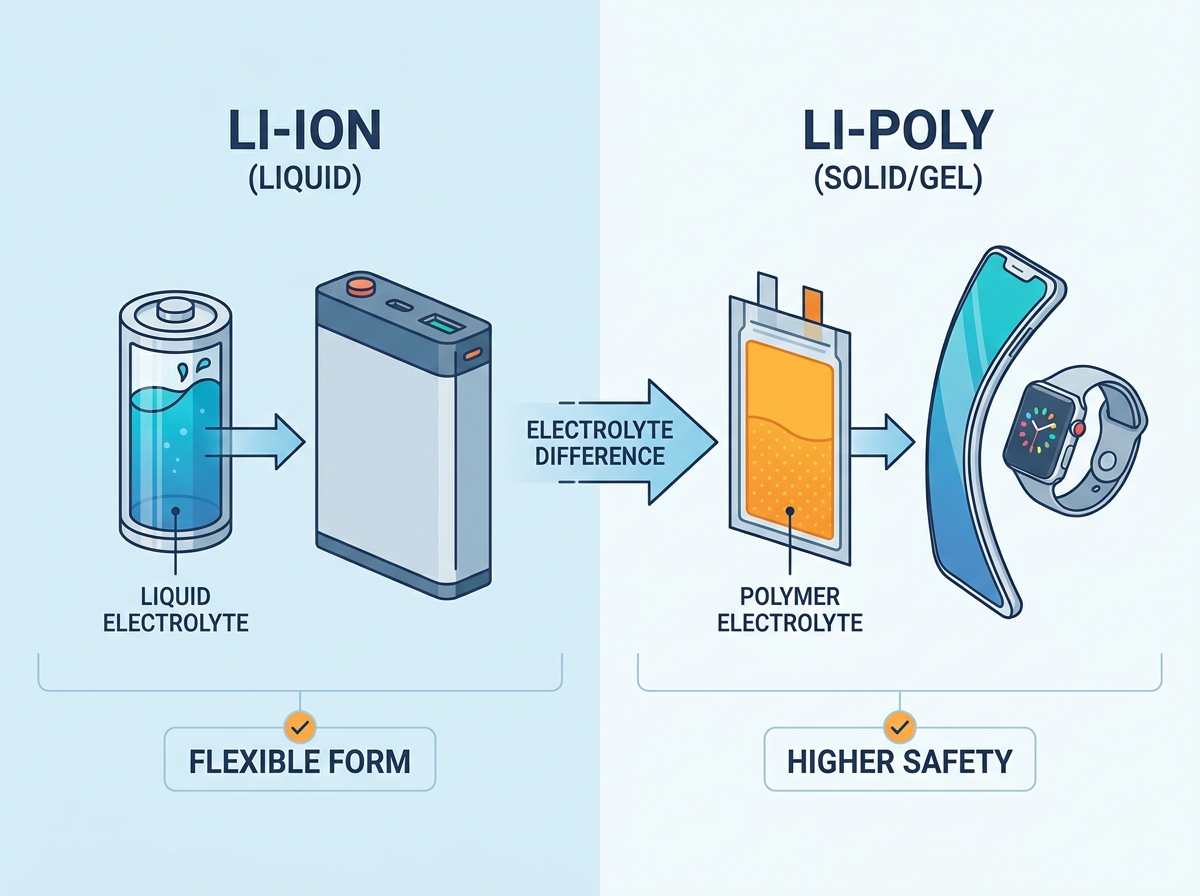
The most immediate structural difference between standard lithium-ion and lithium polymer cells lies in the casing. Standard Li-ion cells, such as the ubiquitous 18650 or 21700 formats, rely on rigid steel or aluminum cylinders. LiPo cells utilize a flexible, lightweight laminated aluminum pouch. This structural divergence directly impacts how engineers integrate the power source into physical device housings. You cannot simply drop a pouch cell into a spring-loaded battery sled; it requires dedicated internal mounting and physical protection.
Engineers must understand the distinction between energy density and specific energy when evaluating these chemistries. Standard cylindrical Li-ion cells typically offer higher volumetric energy density, measured in watt-hours per liter (Wh/L). The rigid casing allows for tight winding of the internal materials, maximizing capacity within a specific volume. Conversely, LiPo cells offer superior specific energy, measured in watt-hours per kilogram (Wh/kg). By eliminating the heavy metal shell, the power-to-weight ratio improves drastically, making them ideal for flight and wearable applications.
The safety profiles of both technologies present different engineering challenges. Standard Li-ion cells carry a risk of liquid electrolyte leakage if the metal casing ruptures. The semisolid gel status of LiPo reduces the hazard of chemical spills. However, the soft pouch increases susceptibility to localized puncture and physical deformation. A sharp internal component can easily pierce a pouch cell, whereas a cylindrical cell would deflect the impact. Both chemistries will enter thermal runaway if internally shorted, but the physical triggers differ.
Manufacturing complexity also varies. Cylindrical Li-ion production is highly automated and standardized, resulting in massive economies of scale and consistent batch quality. LiPo manufacturing involves customizable, slightly more labor-intensive processes, particularly during the vacuum sealing and folding of the pouch edges. This flexibility allows for rapid prototyping but requires strict quality control to prevent moisture ingress during sealing. A poorly sealed pouch will inevitably swell as moisture reacts with the electrolyte to form gas.
Lithium polymer cells can be engineered for exceptionally high continuous and burst discharge rates, often referred to as C-ratings. Specialized LiPo packs can safely sustain discharge rates exceeding 50C to 100C. A 1000mAh battery rated at 50C can deliver 50 amps of continuous current. This capability makes them highly viable for high-drain applications where immediate, massive power delivery is required, such as drone motors or heavy-duty power tools.
Internal resistance (IR) dictates how efficiently a cell delivers power. The gel polymer and pouch design directly influence baseline IR. As operating temperatures drop, the gel's viscosity increases, raising internal resistance and temporarily reducing available capacity. Under heavy load, high IR leads to rapid heat generation, necessitating careful thermal management design within the device enclosure. Engineers must measure IR across the intended operating temperature range to ensure the battery can meet peak current demands without overheating.
Voltage characteristics remain consistent with broader lithium-ion technology. The nominal voltage typically sits between 3.7V and 3.8V per cell. Peak charge voltage reaches 4.2V, though high-voltage variants (LiHv) can safely charge to 4.35V to squeeze out extra capacity. The safe discharge cut-off voltage is strictly defined around 3.0V. Draining a cell below this threshold causes irreversible chemical damage, dissolves the copper current collectors, and leads to structural swelling upon recharge.
Cycle life expectations for LiPo cells are generally lower than hard-cased alternatives. A standard LiPo cell typically delivers 300 to 500 full charge-discharge cycles before degrading to 80% of its original capacity. Engineers must compare this benchmark against more robust chemistries like Lithium Iron Phosphate (LiFePO4), which can easily exceed 2,000 cycles, when determining the appropriate technology for products requiring long-term, daily cycling.
| State | Standard LiPo (V/cell) | High-Voltage LiPo (LiHv) (V/cell) |
|---|---|---|
| Maximum Charge Voltage | 4.20V | 4.35V |
| Nominal Voltage | 3.70V | 3.80V |
| Storage Voltage | 3.80V - 3.85V | 3.85V - 3.90V |
| Absolute Minimum Discharge | 3.00V | 3.00V |
The most significant engineering advantage is form factor customization. Manufacturers can produce cells as thin as 1 millimeter. Furthermore, the pouch architecture allows for curved, stepped, or asymmetrical shapes designed to fit proprietary, non-standard device housings. This flexibility allows industrial designers to maximize internal volume usage without being constrained by standard cylindrical dimensions. You can design the device first and have the battery manufactured to fill the remaining negative space.
Weight optimization is a critical factor for many modern devices. Eliminating the metal enclosure yields substantial weight savings. This reduction is an absolute requirement for aerospace components, unmanned aerial vehicles (UAVs), and wearable electronics, where every gram directly impacts flight time or user comfort. A lighter battery also reduces the mechanical stress on internal mounting brackets during drop tests.
The semisolid gel polymer electrolyte inherently prevents hazardous liquid leakage. If a traditional cylindrical Li-ion cell ruptures, the liquid electrolyte can leak onto sensitive printed circuit boards (PCBs), causing immediate shorts and chemical corrosion. The gel structure of a LiPo cell remains contained even if the outer foil is compromised, mitigating this specific failure mode and protecting surrounding electronics from chemical damage.
For hardware startups and low-volume production runs, custom LiPo dimensions require significantly lower upfront tooling costs compared to custom hard-case prismatic batteries. Modifying the footprint of a pouch cell involves adjusting the cutting dies and sealing jigs, which is vastly cheaper than machining new steel molds for rigid cans. This lowers the barrier to entry for custom hardware development.
Cell swelling, often referred to as puffing, is a chemical reality of pouch cell architecture. Gas generation occurs due to electrolyte decomposition caused by overcharging, overheating, physical abuse, or simple aging. Mechanical designers must leave a 10% expansion gap within physical enclosures to accommodate potential swelling without placing pressure on displays, PCBs, or structural seams. Failing to account for this expansion will result in cracked screens or popped device housings.
The lack of a protective outer metal casing introduces physical puncture and impact vulnerability. Sharp internal board components, stray screw tips, or external impacts can easily puncture the aluminum laminate pouch. A puncture exposes the highly reactive internal layers to oxygen and moisture, leading immediately to short circuits, thermal runaway, and fire. Protective physical barriers within the device chassis are mandatory. You must route wires away from the pouch edges and ensure no sharp solder joints face the battery compartment.
Fire hazards and thermal runaway remain a serious concern under abuse conditions. While the gel electrolyte reduces leakage, the core chemistry remains highly energetic. Mitigation strategies require thermal potting, the integration of phase change materials to absorb excess heat, and the use of fire-resistant enclosure materials (such as UL94 V-0 rated plastics) to contain potential failures. You must design the enclosure to vent gases safely away from the user if a cell vents.
Mandatory BMS integration is non-negotiable. A robust Battery Management System or Protection Circuit Module (PCM) must be hardwired to the cell. This system enforces strict overvoltage, undervoltage, overcurrent, and temperature cut-offs. For multi-cell configurations, the BMS must also include active cell balancing to ensure no individual cell exceeds safe voltage limits during the charge cycle. Relying solely on the device's main processor for battery protection is a severe safety violation.
Storage and maintenance vulnerabilities dictate how devices are warehoused before sale. Rapid capacity degradation occurs if cells are stored at a full charge (4.2V/cell) for extended periods. Conversely, allowing cells to drop below minimum voltage thresholds due to self-discharge will permanently ruin the battery. Warehousing protocols must ensure cells are stored at an optimal 3.8V. You must implement a shipping mode in your device firmware that disconnects the battery from the main circuit to minimize parasitic drain during transit.
In consumer electronics and wearables, internal volume is at an extreme premium. Smartwatches, fitness trackers, and slim-profile laptops rely exclusively on ultra-thin LiPo cells. The ability to shape the battery around curved wristbands or behind thin display panels makes this chemistry the only viable choice for modern ergonomic designs. Engineers can utilize stepped LiPo cells to fill the irregular spaces behind curved laptop chassis, maximizing battery capacity without increasing device thickness.
The UAV, drone, and RC vehicle industries depend heavily on this technology. The high C-rating, low weight, and rapid discharge capabilities make LiPo the undisputed industry standard for aerial applications. Heavy cylindrical cells would drastically reduce payload capacity and flight times, making pouch cells the mandatory power source for high-performance flight. Drone manufacturers often utilize high-voltage LiHv packs to squeeze extra flight time out of the same physical footprint.
Medical devices and IoT sensors utilize custom-shaped cells for portable diagnostic equipment and wearable patient monitors. Remote IoT nodes often require specific geometric footprints to fit inside weatherproof enclosures or attach to industrial machinery. The lightweight profile and customizable dimensions allow engineers to deploy sensors in locations where bulky battery packs would be obtrusive. Medical applications also benefit from the lack of liquid electrolyte, reducing contamination risks in sterile environments.
Global market access and shipping logistics require strict adherence to safety certifications. Commercial deployment is impossible without verifying these standards. UN38.3 is the mandatory safe transport testing standard, subjecting cells to vibration, thermal shock, impact, and external short circuit testing. You cannot legally ship lithium batteries via air freight without passing UN38.3. UL1642 and UL2054 dictate safety standards for the batteries themselves, while IEC 62133 outlines international safety requirements for portable sealed secondary cells.
Supplier quality assurance is critical when selecting a manufacturing partner. Auditing a manufacturer requires evaluating their cleanroom classifications to ensure moisture control during assembly. Automated electrode coating machinery must be inspected for consistency. Cell matching tolerances must be extremely tight for multi-cell packs, and procurement teams must review historical defect rates, typically measured in Defective Parts Per Million (DPPM), to gauge reliability. You must demand full traceability for every cell batch to isolate potential manufacturing defects quickly.
A: A standard lithium polymer battery typically lasts between 300 and 500 full charge cycles before its capacity degrades to 80% of its original rating. Factors that accelerate this degradation include operating at high temperatures, deep discharging below 3.0V, and storing the battery at maximum voltage for extended periods.
A: They present different safety trade-offs. LiPo batteries have a lower risk of liquid electrolyte leakage due to their gel structure. However, their soft pouch shell makes them highly susceptible to physical puncture. Both chemistries carry similar thermal runaway and fire risks if electrically or physically abused.
A: Swelling is caused by electrolyte oxidation and gas generation inside the sealed pouch. This chemical reaction is triggered by overheating, overcharging, deep discharging, or manufacturing defects such as moisture contamination during the initial assembly process.
A: No. Swelling indicates irreversible chemical degradation and physical damage to the internal layers. A swollen cell cannot be repaired or deflated safely. It must be safely discharged and disposed of immediately at a designated hazardous waste facility.
A: The industry standard storage charge is approximately 3.8V to 3.85V per cell. Storing a battery at this specific voltage prevents rapid capacity loss and mitigates self-discharge hazards during long-term inactivity or warehousing.
A: Yes. They require a charger utilizing a Constant Current/Constant Voltage (CC/CV) algorithm designed specifically for lithium chemistries. Furthermore, multi-cell packs absolutely require balance charging to ensure every individual cell maintains identical voltage levels.


